
What Is Ascorbyl Glucoside? A Deep Dive into This Stable Vitamin C Derivative
If you’ve ever struggled with vitamin C products turning brown before use or stinging sensitive skin, you’re not alone. Pure vitamin C (L-ascorbic acid) is a skincare powerhouse—yet its notorious instability and sharp acidity have long frustrated both users and formulators. Enter ascorbyl glucoside (scientifically known as 2-O-α-D-glucopyranosyl-L-ascorbic acid, often abbreviated AA2G), a vitamin C derivative that solves these flaws while preserving the core benefits. Let’s break down its chemistry, advantages, scientific backing, and real-world applications.
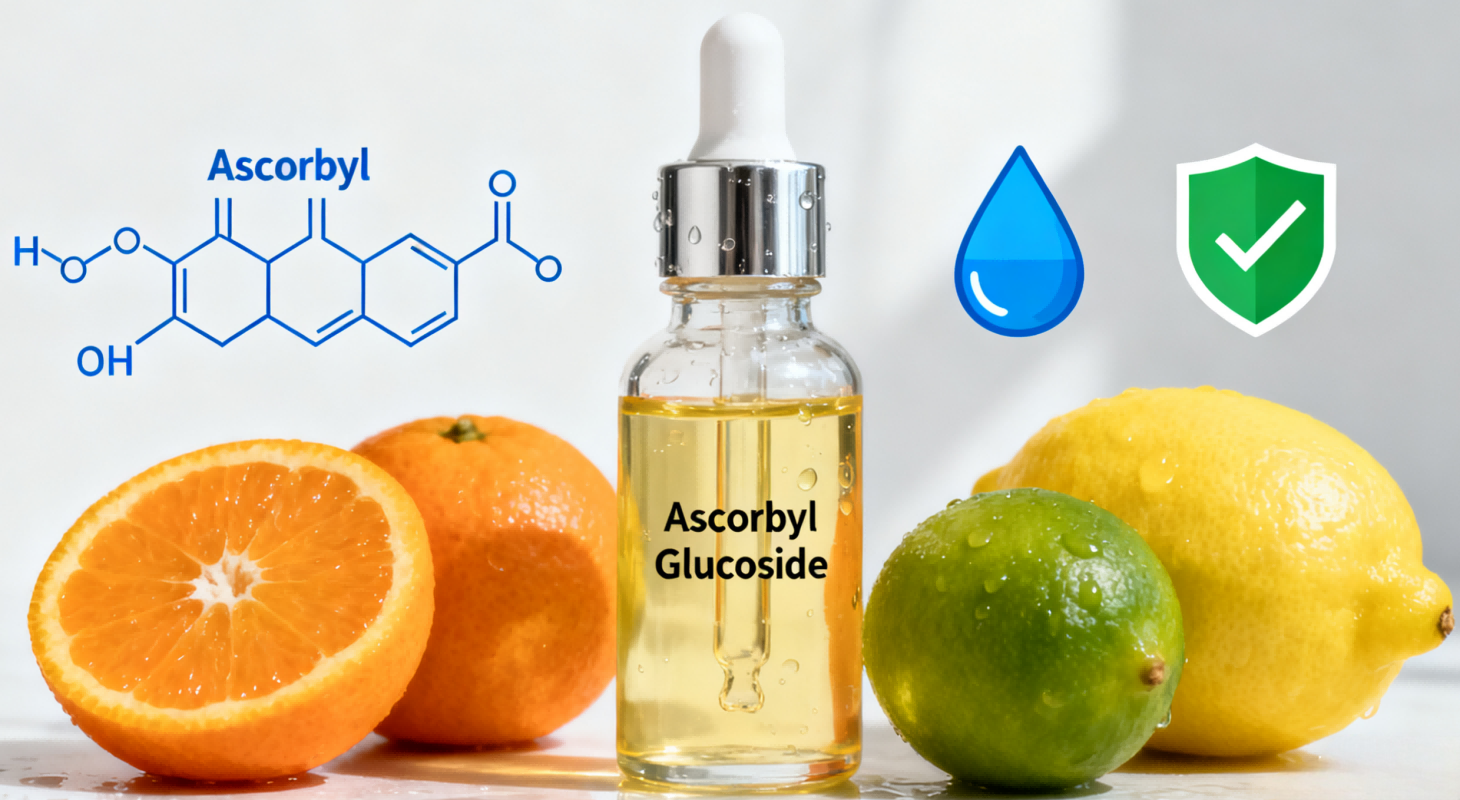
| What Exactly Is Ascorbyl Glucoside? At its core, ascorbyl glucoside is a chemically optimized form of vitamin C, created by bonding a molecule of L-ascorbic acid with a glucose molecule at the 2-position of its structure . This seemingly small modification transforms its properties entirely: while pure vitamin C oxidizes rapidly when exposed to light, heat, or oxygen, the glucose “shield” stabilizes the molecule by protecting its easily damaged hydroxyl groups . Chemically, it has a molecular formula of C₁₂H₁₈O₁₁ and a molecular weight of 338.27, with a melting point ranging from 158.5–159.5℃ . Unlike some vitamin C derivatives that only function in narrow pH windows, ascorbyl glucoside remains active in a pH range of 5–7—perfectly aligned with the skin’s natural slightly acidic environment (typically pH 4.5–5.5) . Its delivery mechanism is equally clever: when applied topically, skin-resident enzymes called α-glucosidases break the bond between vitamin C and glucose, releasing pure, active L-ascorbic acid directly within skin cells . This “slow-release” process ensures a steady supply of vitamin C without overwhelming the skin—a key factor in its gentleness and efficacy. |  |
How It’s Made: From Lab to Formulation
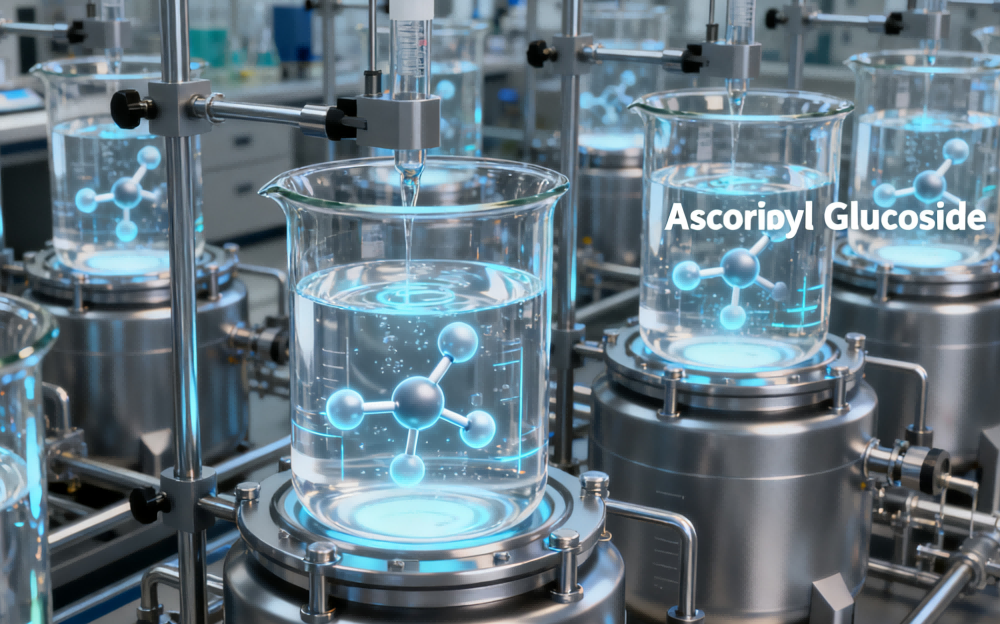
A typical manufacturing workflow includes four key steps :
Initial Purification: The reaction mixture containing ascorbyl glucoside is first processed through nanofiltration to remove residual unreacted vitamin C.
Glucose Removal: A continuous fluid separation system strips away excess glucose, ensuring the final product is concentrated.
PH Adjustment & Desalting: The solution is treated with cation exchange resins to balance pH, followed by another nanofiltration step to eliminate inorganic salts.
Concentration & Crystallization: The purified solution undergoes vacuum distillation to boost concentration, then crystallizes into a stable powder ready for cosmetic formulations.
The Key Advantages Over Pure Vitamin C & Other Derivatives
Ascorbyl glucoside isn’t just a “better” vitamin C—it’s a more practical and versatile one. Its advantages become even clearer when compared to pure ascorbic acid and other common derivatives:
Unmatched Stability for Longer-Lasting Products
- Pure vitamin C oxidizes within weeks of opening, even in opaque, airtight bottles. Ascorbyl glucoside, by contrast, resists oxidation, heat, and light degradation. This stability eliminates the need for excessive preservatives or impractical packaging, making products both safer and more sustainable.
Gentle Enough for All Skin Types (Including Sensitive Skin)
- Pure vitamin C requires a highly acidic pH (3–4) to penetrate the skin, which often triggers redness, stinging, or peeling—especially for those with rosacea, eczema, or post-procedure skin. Ascorbyl glucoside avoids this irritation: its neutral pH and slow-release mechanism prevent sudden spikes in skin acidity.
Superior Penetration via Dual Solubility
- Pure vitamin C is strictly water-soluble, limiting its ability to cross the skin’s lipid (oil-based) barrier. Ascorbyl glucoside, uniquely, dissolves in both water and oil . This amphiphilic property lets it penetrate deeper into the epidermis and dermis—where collagen production occurs and melanin is synthesized—delivering benefits exactly where they’re needed most. This sets it apart from derivatives like magnesium ascorbyl phosphate, which struggles with skin penetration .
Multi-Purpose Efficacy Backed by Mechanism
It doesn’t just fix stability issues—it delivers tangible results through well-understood biological pathways:
- Melanin Reduction: By inhibiting tyrosine enzyme (the rate-limiting enzyme in melanin production) and converting melanin intermediates like dopaquinone back to lighter compounds, it fades existing dark spots and prevents new ones .
- UV Damage Repair: Neutralizes free radicals generated by sun exposure, reducing post-UV redness and preventing photoaging .
- Collagen Boost: Acts as a co-factor for prolyl and lysyl hydroxylase—enzymes that cross-link collagen fibrils—strengthening skin structure .
- Antioxidant Protection: Scavenges reactive oxygen species (ROS) from pollution and stress, preserving skin elasticity .
The Science: Clinical Studies That Prove Its Value
- Whitening Efficacy: Visible Results Without Irritation
A 2023 clinical trial in the Journal of Cosmetic Dermatology tested a 2% ascorbyl glucoside serum on 50 participants with UV-induced sunspots. After 8 weeks, 76% saw a 30% reduction in spot darkness, and 92% reported no stinging or redness . A separate 12-week split-face study of 40 Japanese women yielded similar results: the side treated with 2% ascorbyl glucoside showed significant lightening of hyperpigmentation compared to the placebo side, with dermatologist scores confirming visible improvement .
- UV Protection Enhancement: A “Second Line of Defense”
Researchers at the University of Tokyo found that adding 1% ascorbyl glucoside to sunscreen reduced UV-induced free radical damage by 47% compared to sunscreen alone . This synergistic effect works because sunscreen blocks UV rays, while ascorbyl glucoside neutralizes the ROS that still slip through—addressing “hidden” photoaging.
- Collagen Synthesis: Firming Effects Confirmed
A 2022 in-vitro study in Cosmetics magazine demonstrated that ascorbyl glucoside increased collagen production in human dermal fibroblasts by 58% after 72 hours. Critically, this was achieved without the cell irritation seen with pure vitamin C at the same concentration . A clinical study further supported this: cutometer readings showed statistically significant improvement in skin elasticity (spring-back) after 12 weeks of use, confirming collagen-supporting activity .
How Cosmetics Brands Are Using Ascorbyl Glucoside
- Brightening Serums: The Star Ingredient
Serums typically use 2–10% ascorbyl glucoside as the primary active, paired with hyaluronic acid for hydration or ferulic acid for enhanced antioxidant effects.
- Sunscreens: Boosting Protection Beyond Filters
Many modern sunscreens add 0.5–2% ascorbyl glucoside to combat “post-sun damage.” Unlike chemical filters that degrade with UV exposure, ascorbyl glucoside remains active, neutralizing free radicals that cause premature aging .
- Anti-Aging Moisturizers: Daily Collagen Support
Day and night creams use 1–5% ascorbyl glucoside to boost collagen while maintaining hydration. Formulators prefer it because it mixes seamlessly with other anti-aging ingredients like peptides and ceramides without breaking down—something pure vitamin C cannot do .
- Spot Treatments: Targeted Hyperpigmentation Fixes
High-concentration (5–10%) ascorbyl glucoside treatments target stubborn concerns like acne scars and melasma.
How to Choose & Use Ascorbyl Glucoside Products
To maximize benefits, keep these tips in mind:
- Check Concentrations: Look for 2–10% for daily use (serums/moisturizers) or 5–10% for targeted spot treatments.
- Pair Strategically: Combine with hyaluronic acid for hydration or sunscreen for amplified UV protection. Avoid mixing with other harsh actives like high-concentration retinol—unless your skin is acclimated.
- Store Simply: Unlike pure vitamin C, it doesn’t require refrigeration—just keep it away from direct sunlight.
- Be Patient: Results take 4–8 weeks for brightening and 8–12 weeks for collagen-related firming, thanks to its slow-release mechanism .
Is Ascorbyl Glucoside Right for You?
This derivative is a game-changer if you:
Have sensitive, acne-prone, or post-procedure skin that reacts to acidic products.
Hate wasting oxidized vitamin C serums before finishing them.
Want to target multiple concerns (brightening, anti-aging, sun repair) in one step.
Prefer skincare with transparent, research-backed ingredients.
It’s less necessary only if you have extremely resilient skin and prioritize “instant” result.
Conclusion
Ascorbyl glucoside represents a breakthrough in vitamin C skincare: it retains the benefits of pure ascorbic acid while solving its biggest flaws. Its stability makes products more reliable, its gentleness opens vitamin C to sensitive skin users, and its deep penetration ensures results that go beyond the surface. With over four decades of research and adoption by leading brands, it’s no wonder it’s become a staple in modern skincare.
- Name: Yuki
- E-mail: sales02@nahanutri.com
- WhatsApp:+8618066950297